Affiliate pages can rank on Google.
Not the pages that list ten random products, copy the Amazon description, add a few buttons, and call it a “review.” Those pages are everywhere. And most of them deserve to stay buried.
The real question is not:
“Can affiliate pages rank?”
“Why would Google choose my affiliate page over the 500 others saying almost the same thing?”
That is where most beginners get stuck.
They think SEO is about keywords, backlinks, and plugins. And yes, those things matter. But they are not the foundation. The foundation is usefulness. Google has been very clear that its systems are designed to reward helpful, reliable, people-first content, not content created only to manipulate rankings.
So if you want to rank affiliate pages in Google, you need to stop thinking like a salesperson and start thinking like the person searching.
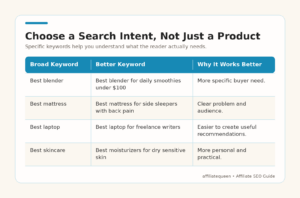
Step 1: Choose a Search Intent, Not Just a Product
Here’s the first mistake beginners make.
They pick a product and build a page around it.
The problem is that those keywords are usually too broad, too competitive, and too vague. A person searching “best blender” could be a college student, a mom making smoothies, a chef, or someone trying to make baby food.
Those are very different people.
A stronger affiliate page starts with a specific search intent.
The more specific the search, the easier it is to understand what the reader actually needs.
And when you understand what they need, your content gets better.
Step 2: Make the Page Actually Helpful
Most affiliate content is not helpful. It is just organized selling.
A helpful affiliate page does not simply say, “This product is amazing, click here.” It explains why a product makes sense for a certain type of person.
There is a big difference.
A weak recommendation says:
“This coffee maker is one of the best on the market and has great features.”
A stronger recommendation says:
“This coffee maker makes sense if you live alone, have limited counter space, and want something simple for weekday mornings. I would not recommend it for a large family because the water tank is small.”
One sounds like marketing copy. The other sounds like a human who actually understands the buyer.
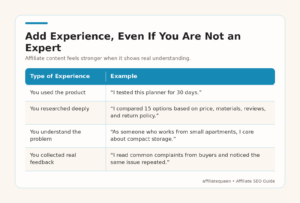
Step 3: Add Experience, Even If You Are Not an Expert
You do not need to be the world’s leading expert to create a good affiliate page.
But you do need to show some kind of real understanding.
Google talks about E-E-A-T: Experience, Expertise, Authoritativeness, and Trustworthiness. In simple terms, this means your content should feel like it was created by someone who knows what they are talking about, or at least someone who has done the work to help the reader make a better decision.
Experience can look like this:
The key is to avoid sounding generic.
If your review could be copied and pasted onto any product in the category, it is not strong enough.
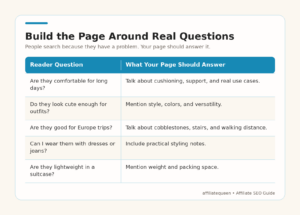
Step 4: Build the Page Around Real Questions
People do not search because they want content.
They search because they have a problem.
Before writing an affiliate page, ask yourself what the reader is trying to figure out.
For example, if the topic is “best walking shoes for travel,” the reader may be wondering:
Tools like Google Trends, Google Search Console, Google Keyword Planner, Ubersuggest, Semrush, Ahrefs, and AnswerThePublic can help you find what people are searching for. But the tool is only the starting point. Your job is to turn the keyword into a useful page.
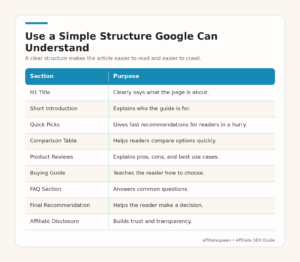
Step 5: Use a Simple Structure Google Can Understand
Good SEO is not about making content complicated.
It is about making it clear.
Your page should be easy for both people and search engines to understand. That means clear titles, logical headings, simple paragraphs, comparison sections, and direct answers.
A beginner friendly affiliate article could look like this:
Here is a simple example.
Title: Best Coffee Makers for Small Apartments
Intro: If you live in a small apartment, you probably do not need a giant coffee machine taking over your counter. This guide focuses on compact coffee makers that are easy to use, easy to clean, and practical for everyday mornings.
Quick Picks: Best overall, best budget, best for espresso lovers, best for tiny kitchens.
Buying Guide: Explain size, water tank, cleaning, price, and coffee style.
Final Recommendation: If you want the easiest option, choose X. If you care more about taste, choose Y. If you are on a budget, choose Z.
That structure works because it helps the reader move from confusion to clarity.
Step 6: Be Honest About Pros and Cons
This part matters more than people think.
If every product on your page sounds perfect, the page does not feel trustworthy.
Readers know products have downsides. They are not looking for perfection. They are looking for the best fit.
So say the quiet part out loud.
“This is a great option, but it is not ideal if you need something ultra-light.”
“This works well for beginners, but advanced users may find it too basic.”
“This is the prettiest option, but not the most durable.”
Honesty does not hurt conversions.
Because when you admit who a product is not for, your recommendation for who it is for becomes more believable.
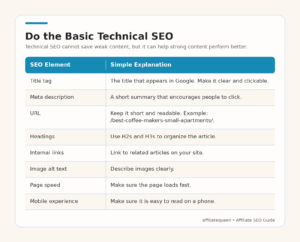
Step 7: Do the Basic Technical SEO
Once the content is useful, then you can optimize it.
Technical SEO will not save a weak article. But it can help a strong article perform better.
Here are the basics worth doing:
You can use PageSpeed Insights to check speed, Google Search Console to track performance, and WordPress plugins like Rank Math or Yoast SEO to help with on-page optimization.
But remember: plugins do not rank pages.
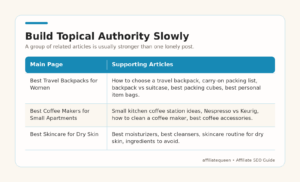
Step 8: Build Topical Authority Slowly
One affiliate article alone can rank.
But a group of related articles is stronger.
If your niche is travel gear, do not only publish “best travel backpack.” Build a small content cluster around the topic.
This helps Google understand what your site is about.
It also helps readers stay longer, click more pages, and trust you more.
Step 9: Add Affiliate Links Naturally
Affiliate links should feel like part of the recommendation, not the whole point of the page.
A bad affiliate page feels like this:
“Buy now. Buy now. Buy now. Buy now.”
A better affiliate page feels like this:
“Here is what I recommend, here is why, here is who it is best for, and here is where you can check the current price.”
Also, be transparent. If you earn a commission, say so. A simple disclosure at the top of the article is enough.
This post may contain affiliate links. If you buy through my links, I may earn a commission at no extra cost to you. I only recommend products that make sense for this topic and audience.
That kind of transparency builds trust.
Real Example: A Weak Page vs. A Strong Page
Let’s say you want to promote standing desks.
A weak page would be called:
It would list ten desks, add star ratings, paste product descriptions, and include buttons.
A stronger page would be:
Best Standing Desks for Small Home Offices
That page would explain desk width, height range, noise level, cable management, stability, budget, and who each desk is best for.
The Simple Rule
If you want to rank affiliate pages on Google, ask this before publishing:
“Would this page still be useful if I removed the affiliate links?”
If the answer is no, the page is not ready.
Because affiliate links should be the monetization layer.
They should not be the entire value of the page.
Final Thoughts
Ranking affiliate pages on Google is not about tricking the algorithm.
It is about being more useful than the next result.
Choose specific keywords. Understand the reader’s problem. Add real experience. Compare honestly. Make the page easy to read. Use basic SEO. Build related content around the topic.
And in a world full of generic affiliate content, sounding like a real person who actually cares is already a competitive advantage.
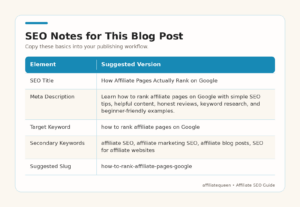
SEO Notes